Civic Engagement Themes Archive
During the 2024-25 academic year, civic engagement activities at Bluffton will focus on the relationship between faith and memory during challenging times.
In times of social, political, economic and institutional disruption, as well as personal uncertainty, communities and individuals have turned to faith and to memories of faithfulness as sources of hope and guidance.
The relationship between faith and memory is illustrated in Hebrews chapter 11 as “the assurance of things hoped for.” The writer then recalls faith stories of biblical characters from Abraham and Sarah to Rahab and Gideon. Faith has a history, in other words, with stories by which we remember how to act faithfully—with the assurance of hope rather than the certainty of outcome.
Two significant milestones in Bluffton’s history will be celebrated in 2024-25: the founding of Bluffton University 125 years ago, and of the Anabaptist faith from the beginnings of the Mennonite church 500 years ago. As we remember the stories of Bluffton and of its Christian heritage, we will consider how these memories of faithfulness may help us face the challenges of our time with resilience and hope.
Forum Events
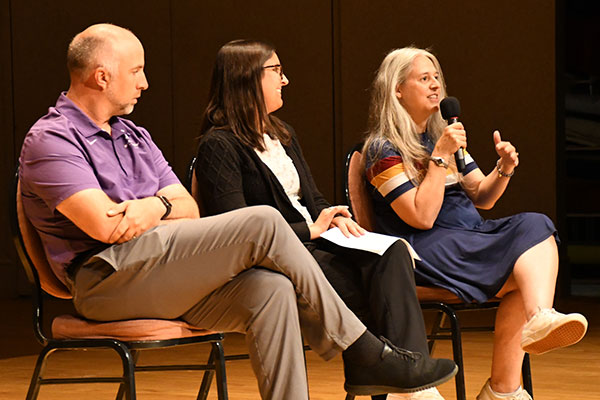
Remember your faith
Bluffton panelists discussed the connection between faith and memory, highlighting the importance of family and close relationships in fostering faith and developing personal experiences.
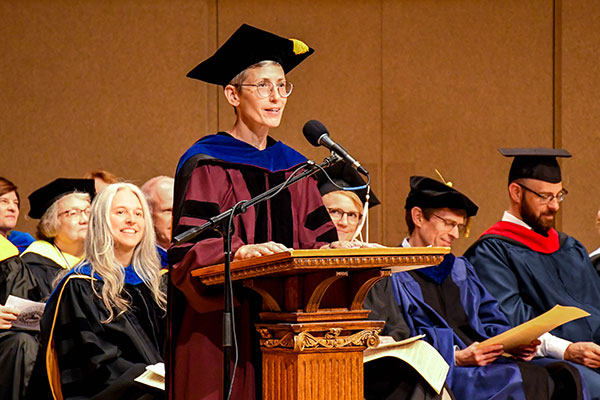
Becoming Rooted
The forum highlighted self-awareness, curiosity, kindness, and letting go of old beliefs to become rooted in a new community, likening personal growth to the interconnectedness of trees.
Mental health and emotional well-being were explored by the Bluffton community during the 2023-24 academic year.
According to the World Health Organization, mental health conditions are increasing across the world. Those concerning increases are mirrored in the U.S. college student population, with a Centers for Disease Control (CDC) study finding that 42% of students in 2021 felt persistently sad or hopeless.
As we explore mental health and emotional well-being during the 2023-24 year, we address a broad range of questions such as: What are the underlying causes of mental health challenges, and how might they be addressed? How can students struggling with mental health conditions best be served? How can a wide-ranging consideration of emotional well-being aid students as they make decisions and navigate challenging life experiences? What resources and tools do students and the broader population need as they navigate these challenges? How can people learn the basic skills needed to navigate new situations so that they lessen stress and anxiety? What approaches can help people feel agency as they make decisions among competing choices?
Forum Events
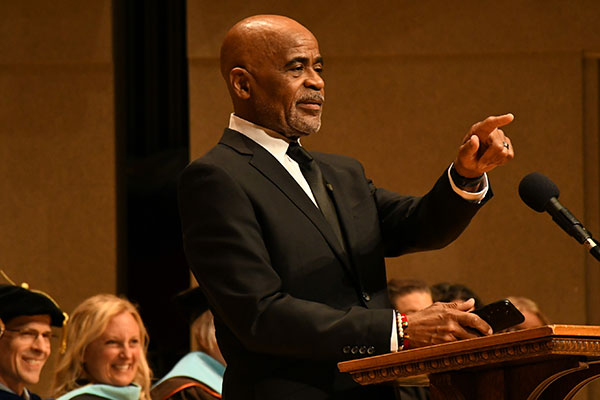
Make wise choices
A businessman and storyteller, Thomas E. “Tucker” Lott encouraged students to make positive choices, and reminded them they can always get back up if they fall “because falling happens.”
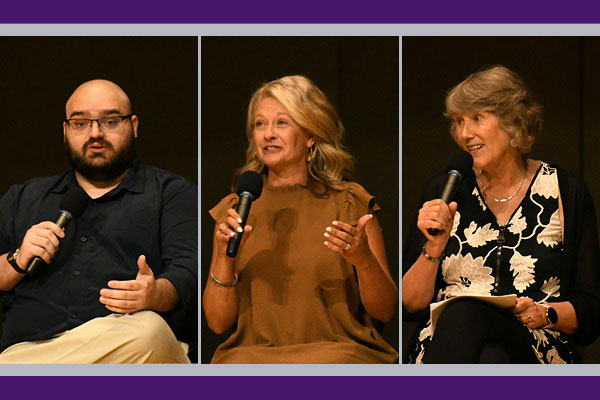
Emotional health
During Bluffton University’s Forum, Panel questions ranged from the reasons why mental health issues are on the rise to the obstacles people face in managing their emotional wellness.
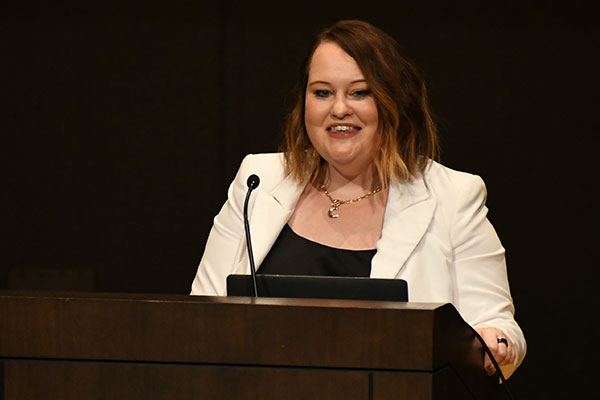
Marketing and mental health
Charlene Coughlin, who's worked with companies ranging from Sherwin-Williams to the Cleveland Natural History Museum, shared several examples of positive marketing.
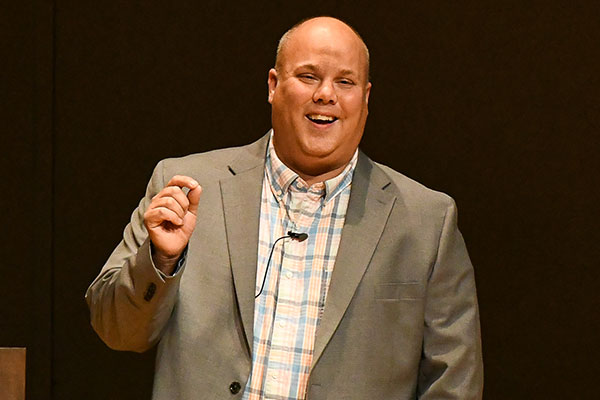
It's okay to fail
While working with the students, David Glick, 2007 alumn and pastor of student ministries at Ebenezer Mennonite Church, was open about his time on campus, including his struggles and successes.
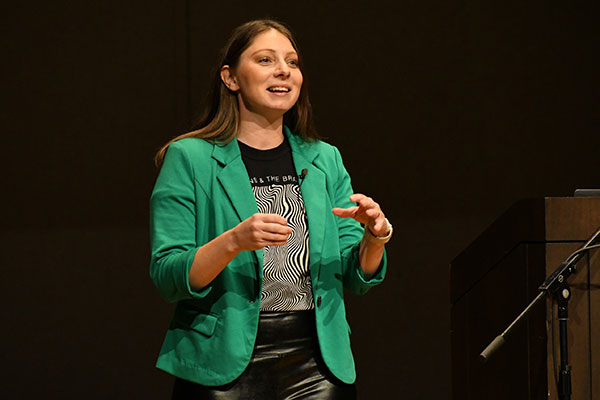
Brave Conversations
Social worker, author, comedian and 2010 graduate, Andrea Flack-Wetherald discussed the truths about starting “brave conversations”, as well as how they build trust and maintain strong relationships.
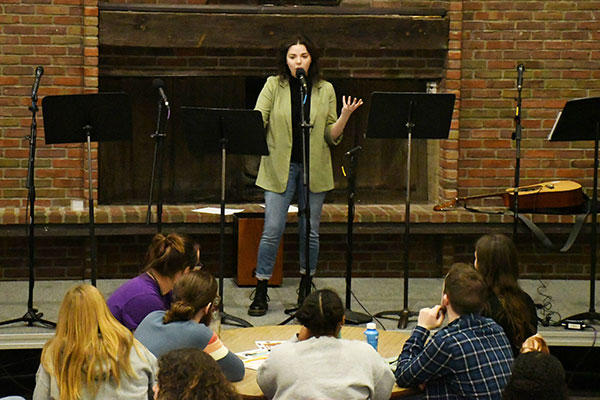
Spiritual wellness
As guest speaker for spring Spiritual Life Week, Lindsay Horn ’19 shared four practices to cultivate an awareness of peace: detachment, silence, meditation and remembrance.
For the 2022-23 year, our campus community explored how we can evaluate evidence and competing claims to work toward a shared understanding.
We have all been in a conversation with a friend about a past event we’ve shared together when we’re shocked to learn that they remember the situation much differently that we do. These differences in perception affect many parts of our lives, as we make decisions based on what we think and believe. People in our country seem increasingly to see news events or scientific findings through disparate lenses. Is it possible to find a consensus to move forward together?
For the 2022-23 year, our campus community explored how we can evaluate evidence and competing claims to work toward a shared understanding. Some questions we considered: How do we evaluate various sources of news or information? What standards of evidence can we agree on to help us find our way? Can we find ways to step outside of the echo chamber of views that mirror our own to understand an alternative perspective? When are positions so far from the evidence that we can reject them out of hand?
First-year student Summer reading
“The Other Wes Moore" chronicles the lives of two men with the same name. Both Wes Moores are black men
who grew up in the inner-city communities. Both were raised by single mothers within
the same era. So how did one end up a decorated military veteran and academic scholar,
and the other a convicted murder with a life sentence?”
Book summary >
Forum events
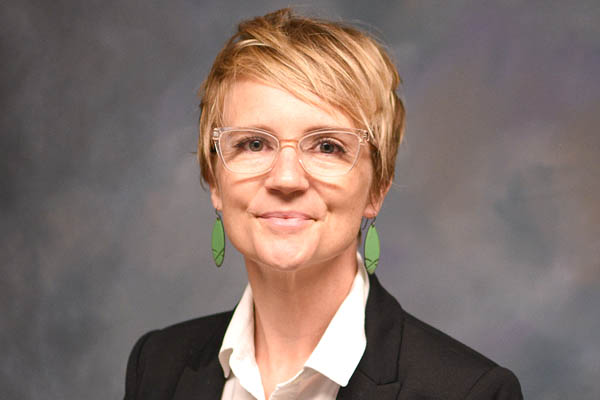
Civic Engagement Lecturer
Marathana Prothro drew from communication and media scholarship for the annual Civic Engagement Day Forum to sketch our media ecosystem. She suggested practices of engagement that foster connection rather than amplify polarization.
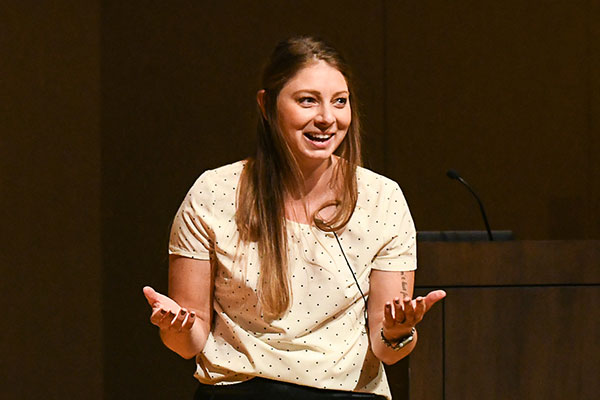
“Let’s Talk”
Recognizing the resilience of today’s young people, Andrea Flack-Wetherald reminded students that every day is an opportunity for collaboration, finding joy and tackling big issues and tools such as mindfulness and improv can be a big help.
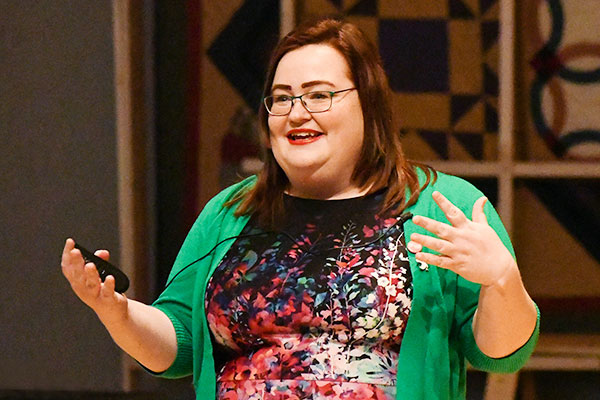
“Let’s Listen”
Bluffton University alumnus Georgia Metz ’13 said the theme, “Let's Listen,” reflects conversations she’s having in her own circles around the polarization of society and the ways technology is changing and shaping us.
For the 2019-20 academic year, the Bluffton campus community explored how we live with wholeness and joy.
According to the 2018 State of American Well-Being study, Ohio ranks 38th among the states on this well-being index. The five elements measured in the study are as follows:
- Purpose: liking what you do each day and being motivated to achieve your goals;
- Social: having supportive relationships and love in your life;
- Financial: managing your economic life to reduce stress and increase security;
- Community: liking where you live, feeling safe and having pride in your community;
- Physical: having good health and energy to get things done daily.
As these categories suggest, our sense of well-being grows from a complex web of interrelated factors. For the 2019-20 academic year, the Bluffton campus community explored how we live with wholeness and joy.
Some questions that shaped our campus conversation: how do we understand Ohio’s low ranking on this index? What external conditions may contribute to or detract from a sense of well-being? How does a community’s health enrich and intersect with an an individual’s wholeness and joy? How can the various academic disciplines help individuals and communities find wholeness or well-being? How have the various places that we have called “home” differently supported our own well-being? How can any of us use the strengths we and our communities possess to find a greater sense of well-being and joy?
First-year Student Summer Reading
The summer reading text for first year students was The Geography of Bliss (One Grump's Search for the Happiest Places in the World) by Eric Weiner. The author describes his travels around the world to learn why people
in various countries are highly ranked on the happiness scale.
Author's description >
Deserving Happiness: A Wisdom Conversation
Dr. Jackie Wyse-Rhodes was the 2019-20 civic engagement lecturer. She presented at the Presidential Scholarship Competition and planned to speak for Civic Engagement Day before it was cancelled due to the COVID-19 pandemic.
In planning her presentation, Dr. Wyse-Rhodes wrote, “The question of how to live a good and meaningful life in the face of human mortality, political instability, and theological doubt is an old question, and a global one. For a community like Bluffton University, who is invested in ecumenical conversations while rooted in an Anabaptist perspective, early Jewish wisdom literature speaks to questions of purpose––how our daily decisions can be motivated by seeking divine presence; to questions of community––how our relationship with money can serve as a diagnostic tool to better understand our persistent anxieties; and to questions of what it means to live as embodied creatures. I argue that biblical wisdom traditions offer a particularly apt model for Bluffton University as we seek to create space for inclusive and incisive dialogue about meaningful living.”
Forum events
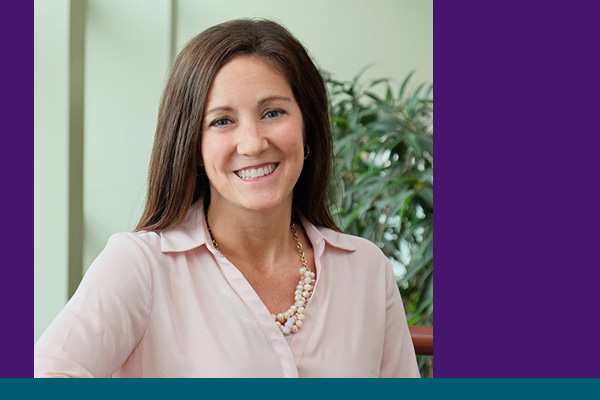
Relationships are key
Relationships, mentorship, education and focus are keys to leadership and professional development says Ronda Lehman, president of Mercy Health.
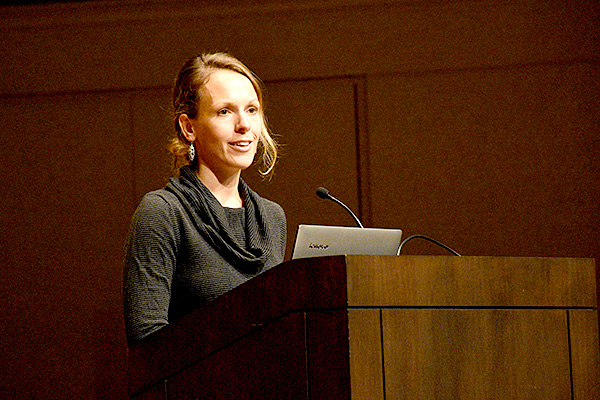
Joy of entanglement
For 2007 graduate Jenna Liechty Martin, living a life of wholeness and joy is only possible in community, a community not just comprised of people.
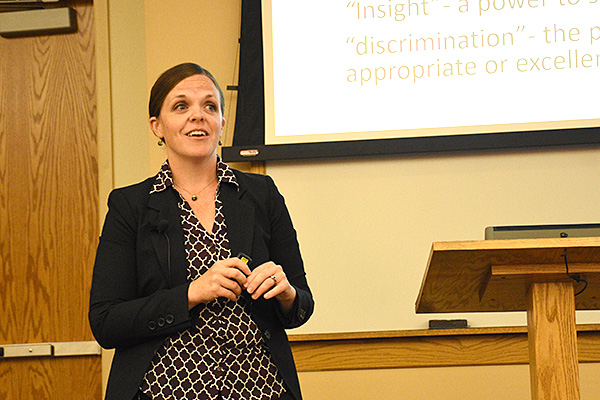
Alumna encourages
Kathy Dickson '03, director of vocational discernment and community engagement at Methodist Theological School of Ohio, provided Bluffton University students with tangible tips and practices for vocational discernment.
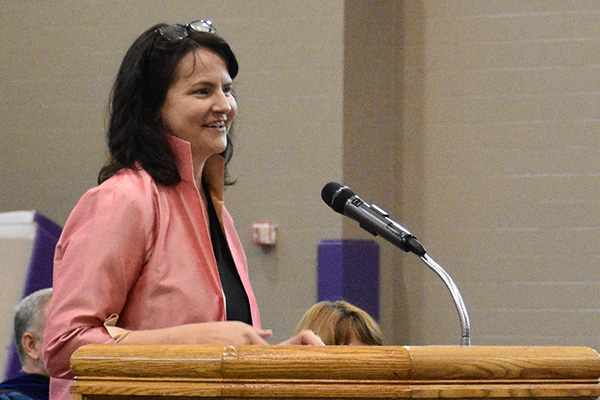
Opening convocation
During a time when, as a whole, our nation's perceived well-being is declining, the importance of relationships was emphasized as a key to happiness during Opening Convocation.
For the 2018-19 academic year, our campus community learned about and put into practice ways to listen to each other.
In our divided nation, almost any event seems to spark widely divergent and caustic responses, depending on one’s loyalties. Even among members of the campus community, potentially controversial topics are often avoided to step away from possible conflicts. Yet we recognize that both as followers of Christ and as citizens of a democracy, we are called to listen and learn from each other. But making ourselves vulnerable through really listening to the other is hard. Rather than remaining only in the safe confines of our group, how can we open ourselves to genuine dialogue? When should we offer informed advocacy for a view, presented with honesty and care? How can we listen carefully enough to hear the pain and fears that sometimes are at the core of the person whose position we find objectionable? How might we be sure to listen carefully to minority or unpopular views? How can we apply such vulnerable listening and speaking in our disciplines, our workplaces, our communities? Throughout the 2018-19 year, we will learn about and put into practice ways to listen to each other.
First-year Student Summer Reading
The summer reading text for first year students was Jonas Beiler’s book, “Think No Evil: Inside the Story of the Amish Schoolhouse Shooting…and Beyond.” The book is a wonderful account of the Nickel Mines Tragedy with an analysis of how Anabaptist theology, and its focus on forgiveness, is affected by its historical development, and how it is lived out in Amish Anabaptist communities today. >>> publisher's description
Civic Engagement Lecturer
Marathana Prothro served as the 2018-19 civic engagement lecturer. She presented "Using Ancient Wisdom to Stop Destructive Communication in its Tracks: Reining in Gottman’s Horsemen."
“My lecture centers on the Four Agreements as described by Don Miguel Ruiz, Jr., and correlates them with what researcher John Gottman describes as the Four Horsemen of the Apocalypse. Gottman is a researcher whose emphasis is on the kinds of communication that bring destruction to relationships—criticism, contempt, defensiveness, and stonewalling. Each of the Four Agreements directly correlates with a seemingly simple (yet beautifully rich) ‘antidote’ to each of Gottman’s ‘Horsemen.’ Though the Agreements — let your word be impeccable, don’t make assumptions, don’t take anything personally, always do your best — draw from ancient wisdom in an oral culture, they are particularly relevant in a post-modern secondary orality and will give students tangible options for moving away from division and toward understanding, without necessarily compromising.”
Forum events

Opening convocation
Jonas Beiler had one passion for many years—to help strengthen families—and has witnessed that passion unfold in numerous ways. After the death of his second daughter in 1975 and the near devastation of his marriage that followed, it was through the help of counseling that his life, his marriage, and his family began to heal. In the fall convocation, Beiler will talk about what he learned about how forgiveness can allow for the most difficult conversations to happen in the midst of tragedy.
For the 2017-18 anniversary, we explored Bluffton's legacy of honor on campus and among graduates in the context of larger conversations about integrity and truth.
Bluffton's honor code celebrated its 100th anniversary in 2018. For 100 years, Bluffton students were taught to uphold the community of respect throughout their campus interactions.
What habits are formed in the community of Bluffton University that may not be present in other, competing narratives of honor? How do ideas of honor, truth and integrity vary in different contexts and cultures? Can upholding a firm sense of honor ever lead to less than honorable actions? How might integrity and respect be embodied in various disciplines or work contexts? What habits supporting honor and integrity are embedded in our athletic teams and might be applied in other areas? In our careers and professions, how might we treat clients, patients, competitors, suppliers or audiences for "internal" reasons of character and not just compliance to "external" standards?
Forum Events
Opening convocation
Our summer reading text was "Quiet Strength: The Principles, Practices, and Priorities of a Winning Life," co-written by Tony Dungy and Nathan Whitaker. The book is a memoir of Tony Dungy's life as he explains the values that have directed his actions and helped him live with integrity through difficult times. Nathan Whitaker was the opening convocation speaker Tuesday, Aug. 29, 2017.
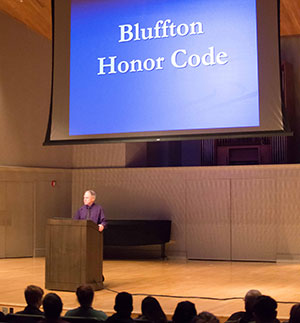
Honor code forum
Dr. Mark Bourassa, assistant dean of students, examined the historical context of honor codes in the United States as well as at Bluffton during the Nov. 14 Forum, “Bluffton’s Honor Code in the World.”
“Honor codes don’t work when they are simply sitting on the shelf,” explained Bourassa. “They work best when we continually seek to engage with each other in understanding the shared values that are embedded in our community.”
Civic Engagement Lecturer
Jonathan Andreas was the 2017-18 civic engagement lecturer. He presented "Worthy of
Honor" on April 10, 2018.
Dr. Jonathan Andreas, associate professor of economics, opened the Civic Engagement
lecture at Bluffton University with a simple question: “What makes the world go round?”
“I’m an economist, and I am here to tell you that it is not money,” joked Andreas.
For the 2016-17 academic year, the Bluffton campus community explored the role of creativity and the arts in civic engagement.
Author Robert Fulghum has observed that when children are in kindergarten, they all say that they can draw, sing, dance and act. Studies have shown that people’s willingness to engage in the arts and to be creative can decrease dramatically as we get older. Yet we all know that to address our world’s pressing challenges, we need to think creatively, to imagine new possibilities, to see in surprising ways.
During this year we explored the role of creativity and the arts in civic engagement. Certainly a particular focus on fine arts and aesthetics was important in our conversation. For example, in what ways should a discussion about beauty enter into our civic discourse? Who controls the power to define what is “art” or what is aesthetically pleasing? How have particular social change movements been influenced by the arts — and art affected by the controversies of its era?
In addition, we explored how creativity and the imagination infuse all disciplines. For instance, how does an appreciation of beauty shape our interactions with other humans and the natural world? How might creativity be nurtured and applied to seemingly intractable problems, such as our fear of people different from us or global responses to climate change or ongoing conflict between Israel and Palestine? More broadly, how can we, whatever our academic discipline, unleash our creative gifts for the purposes of God’s universal kingdom?
Forum Events
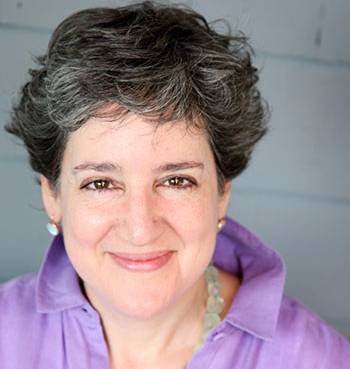
Opening convocation
Peabody Award-winning producer, TED speaker and consultant Julie Burstein, author of the first-year student summer reading assignment "Spark: How Creativity Works," spoke at the Opening Convocation ceremony.
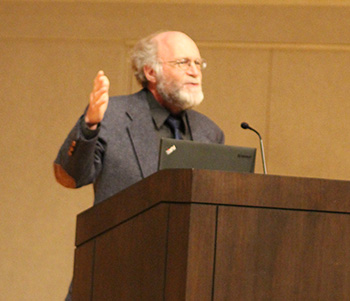
Civic Engagement Day
How do you encapsulate an idea as abstract as beauty? According to Dr. Jeff Gundy, beauty "does not respond well to mere reason." However, during his Civic Engagement Forum Gundy explained that beauty, though abstract and unrestricted, can be captured through ideas, images, poems and songs.
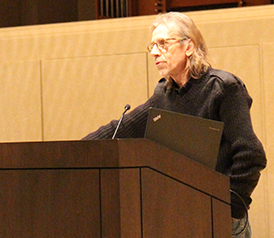
Art and Dissidence in Cuba
A documentary exploring the role of art as a form of activism was previewed. The film is being written, directed and produced by Phil Sugden, assistant professor of art at Bluffton, and Carole Elchert, assistant professor of communication at the University of Findlay.
For the 2015-16 academic year, our campus community explored a wide range of gender questions throughout the year.
Few elements of our identity may seem more basic than the “It’s a girl!” or “It’s a boy!” announcement at a birth. Yet we all recognize that gender roles are not fixed across time or consistent across cultures. How do—and should—we determine the roles that women and men play?
In our conversations, classes and presentations, we anticipate exploring a wide range of gender questions throughout the year. For instance, in the United States and around the world, how do girls and boys differently experience education? How do boys and girls decide what career to pursue? Is Title IX still important? How do media and advertising portrayals of women and men shape our gender assumptions? Does the gender pay gap persist and, if so, how should we respond? How do women and men understand their roles as parents? What attitudes about masculinity and femininity persist that contribute to the reality of sexual violence? Does a gender binary like man/woman still make the most sense in a contemporary worldview? How can Christian understandings of gender roles inform contemporary conversations regarding gender in the church and the world?
Forum Events
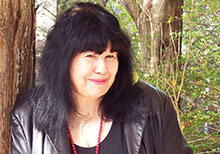
Pay attention
Novelist, poet and memoirist Marge Piercy, author of the first-year student summer reading assignment “He, She and It,” spoke at the Opening Convocation ceremony.
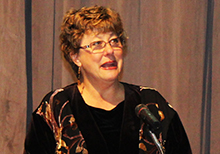
Negotiate the labyrinth
"Glass ceiling" may no longer be the best description of what keeps more women from reaching high-level positions, according to Dr. Kerry Strayer '84, Otterbein associate professor of communication.
Male achievement gap
Since the introduction of Title IX in 1972, there has been a lot of focus on ensuring girls get the same opportunities as boys in public education. However, with so much focus on girls’ achievement many people haven’t noticed that boys are falling behind. Bethel College (Kansas) professor Dr. Doug Siemens explored the role reversal in educational achievement.
Professor turned MMA fighter
Jonathon Gottschall’s presentation, “The Professor in the Cage: Why Men Fight and Why We Like to Watch,” based on the content of his book “The Professor in the Cage.” He explained why an English professor at a small liberal arts college would take up cage fighting for three years.
For the 2014-15 academic year, our campus community explored just what exactly makes education so important.
Many people view attending elementary through high school as a rite of passage, or "just part of growing up," and that often includes college education as well. But for many others a sound education is not only not a normal part of life, it's not even a possibility. Children around the world are barred from attending school due to poverty, conflict and other reasons. For those of us who have had the opportunity to graduate from high school or higher education, education should not be taken for granted.
Topics throughout the year not only challenged the purpose of education, but sought to reinforce the belief that education is vital to human development. Some speakers, such as "What the Best College Students Do" author Ken Bain and Susan Schultz Huxman, president of Canada's Conrad Grebel University College, explained why a liberal arts education makes a positive difference in our world. Other presentations, like Linda Gojak's lecture on Common Core, addressed the ever-changing world of academia.
Our civic engagement speaker this academic year was Kate Spike, Bluffton's professor of Teaching English to Students of Other Languages. For her, education and lifelong learning don't need to be confined to the classroom. Whether we learn in a classroom, a foreign country or in our own backyard, we'll always be learning as long as we leave our comfort zones and engage with others, she said.
Forum Events
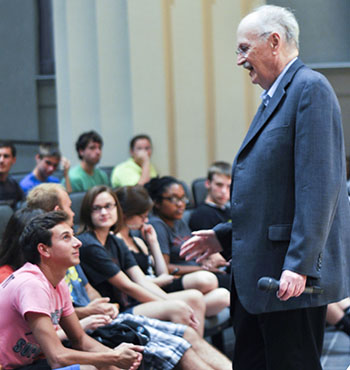
Deep Learning
Dr. Ken Bain, auther of the required summer reading "What the Best College Students Do," spoke at the Opening Convocation. A Northwestern University undergraduate first got Dr. Bain’s attention because he hadn’t read a book assigned by Bain for a history course.
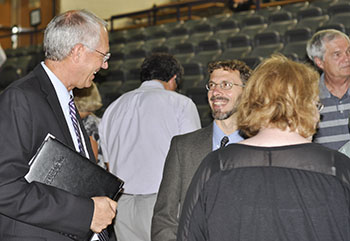
President's Forum
Liberal arts education “makes a difference — for those who receive it and for the society we live in,” Bluffton University’s president reminded students, faculty and staff in his address.
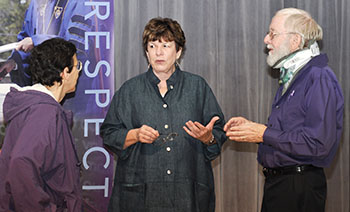
Common Core
The immediate past president of the National Council of Teachers of Mathematics said that she thinks “there’s a lot of misunderstanding” about the Common Core State Standards for math.
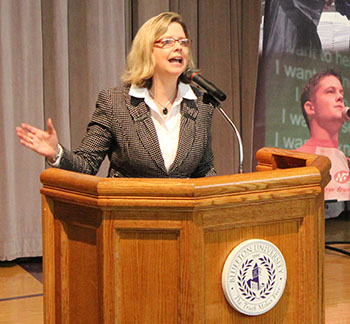
The three 'C's
The three 'R's have been viewed as foundations of education since the days of the one-room schoolhouse. But the president of Canada’s Conrad Grebel University College proposed that the success of small, Christian liberal arts colleges boils down to three 'C's.
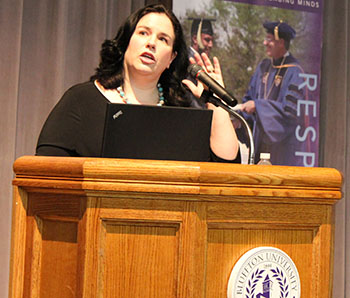
The Contact Zone
The “contact zone,” as defined by Kate Spike, will never be confused with the comfort zone where many people like to spend their time.
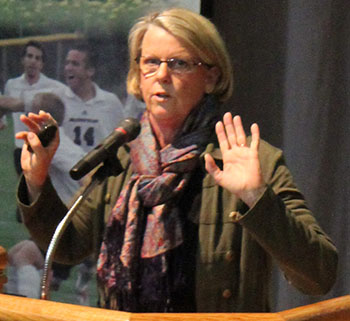
The plot thickens on film
As a scholar of 19th-century women’s literature, Dr. Cheri Larsen Hoeckley knows that marriage plays a central role in many classic novels. But the pressure to get married that can be found in those books also lives on in modern movies and culture, the Westmont College professor says.
For the 2013-14 academic year, our campus community focused on celebrating the particular contributions and experiences of people from varied races and ethnicities.
At the same time, we explored the ongoing struggle in the United States, including our region and our campus, toward equally welcoming people from all racial and ethnic backgrounds. For instance, what do we mean when we use the word "community?" Who is typically included and who is excluded? How do we create a genuinely welcoming community?
Throughout the year, we sought to respond to the challenges before us and identify new opportunities to celebrate our racial and ethnic diversity in ways that help us build more welcoming communities in our region and beyond.
Special guest speakers included Lorene Cary, author of "Black Ice", required reading for first year students; United States Poet Laureate Natasha Trethewey, whose mother attended Bluffton 50 years ago; the reigning Miss America Nina Davuluri and many others.
Forum Events
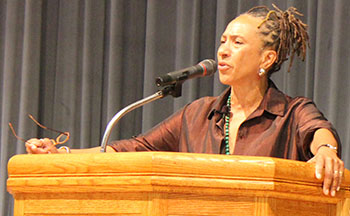
Author opens race discussion
Lorene Cary, author of the required summer reading, Black Ice, spoke at Opening Convocation . Her introduction to a prestigious New England prep school in 1972 was similar in some ways to the welcome afforded first-year Bluffton students, the author told the students that morning.
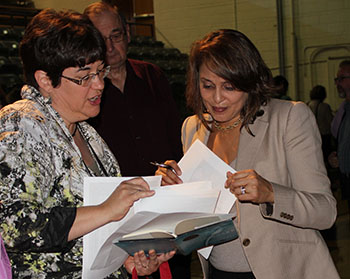
Found family connections
United States Poet Laureate Natasha Trethewey may have taken the first step toward understanding her mother in Bluffton, Ohio. She said as much following an Oct. 15 lecture at Bluffton University, where her late mother, Gwendolyn Ann Turnbough, attended college 50 years ago.
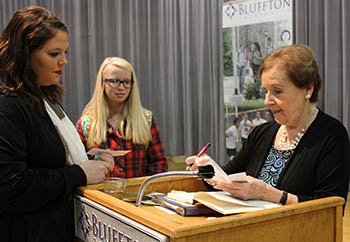
Story of hope
The native of Germany told her story of surviving the Holocaust to visiting high school students and community members, as well as Bluffton faculty, staff and students. And she reminded her youngest listeners that they will be the last generation to hear her, and her peers', stories firsthand.
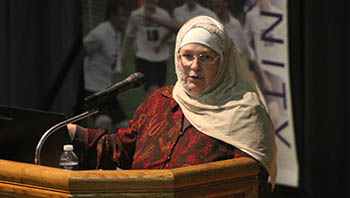
Fundamental rights
Institutionalized profiling of Muslims is undermining American democracy, a leader of Cleveland's Islamic community said.
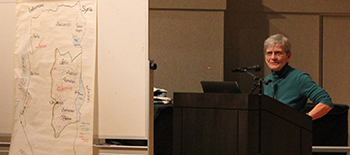
Work for peace
Sister Paulette Schroeder "put her feet where her mouth was," by joining a Christian Peacemaker Teams delegation to the Middle East and the Israeli-occupied West Bank.
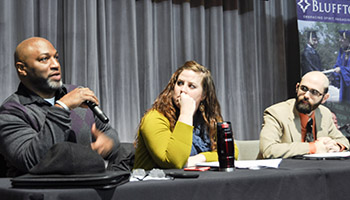
MLK Forum
In recognition of the legacy of Dr. Martin Luther King Jr., five Bluffton University faculty and staff members reflected on the death of Florida teenager Trayvon Martin; the trial of the accused killer, George Zimmerman; and how race still matters in America.
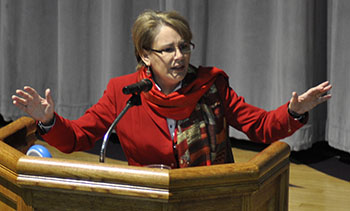
Stories of immigration
The moderator of Mennonite Church USA told of experiences from elementary school in Chicago — where her family had moved from Puerto Rico — and what she called a "stolen" educational foundation.
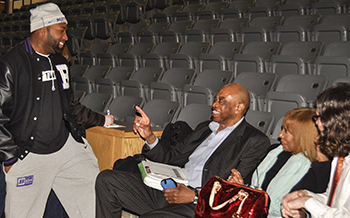
Smucker lecture
Arvis Averette recalled the 1963 March on Washington, saying "the most controversial issue we had" was a call for a minimum wage of $2 per hour.
Civic Engagement
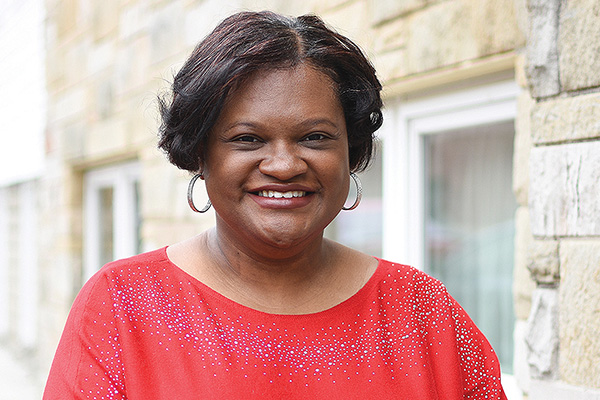
To help illustrate "why racism still exists and that getting over it isn't really that simple," Dr. Crystal Sellers Battle showed a video in which a white haircutter faces prejudice in a Harlem barbershop, and shared two personal "shopping while black" stories.
Miss America
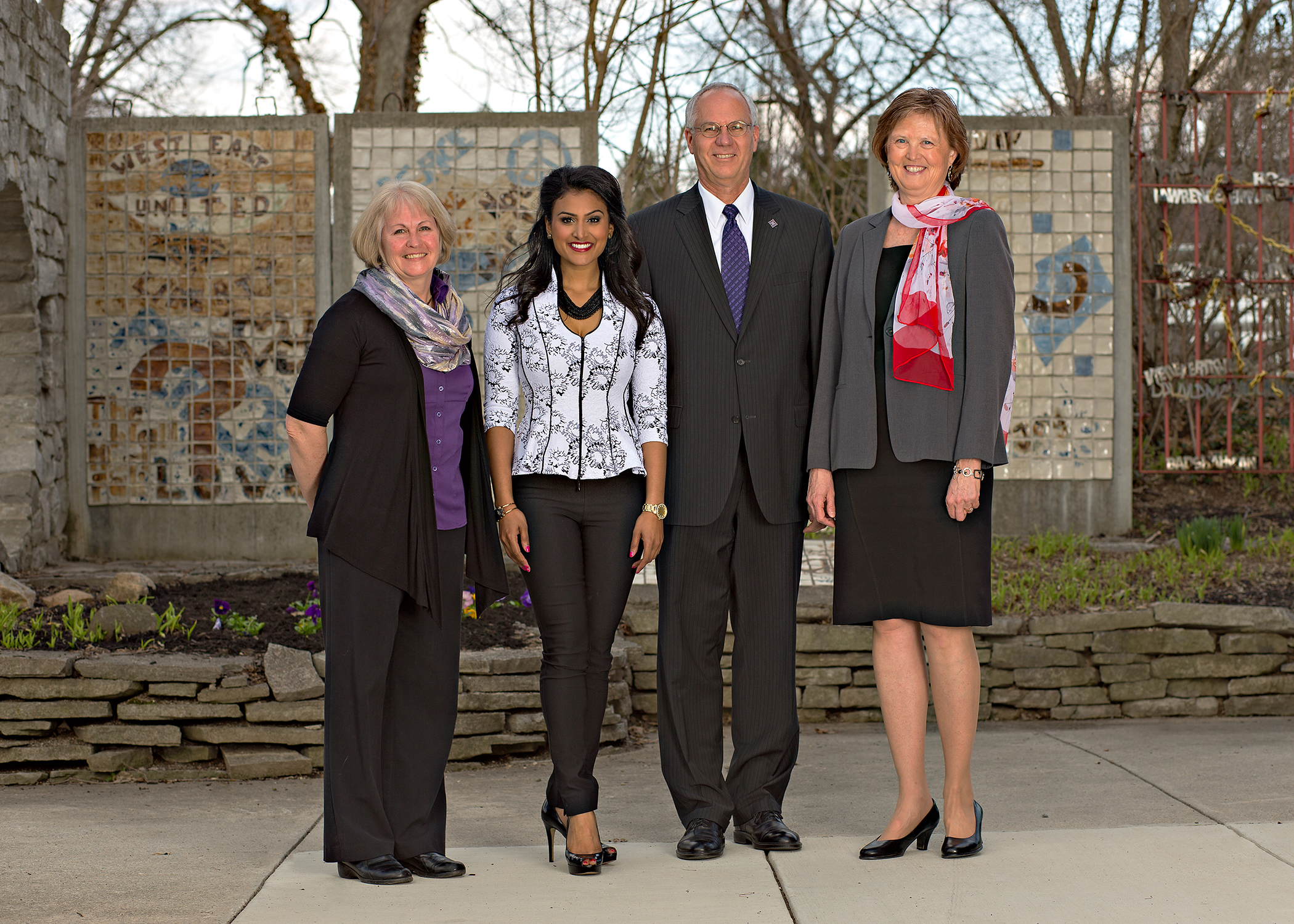
Nina Davuluri, the reigning Miss America and the first of Indian-American descent, brought her message of multiculturalism as keynote speaker for the university's annual civic engagement day.