NetVUE Chaplaincy Panel
09/25/2026
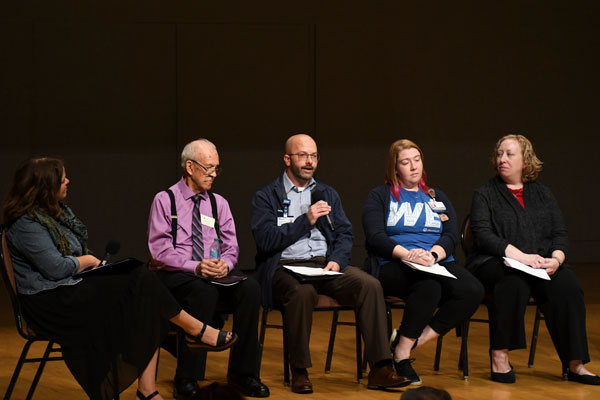
The panelist included Bill Herr ’63, retired chaplain at Mennonite Memorial Home; Shannon Thiebeau ’15, staff chaplain at OhioHealth; Eliza Wertenberger ’07, fetal center chaplain at Nationwide Children’s Hospital; and Phil Wiechart ’01, senior well-being specialist at Corewell Health.
NetVUE Panel Highlights Chaplaincy, Vocation and Meaningful Work
For Bluffton University alumni working in chaplaincy, vocation is found in the relationships they build, the care they provide and the opportunity to support people through life's most difficult moments. During a NetVUE panel, four alumni shared their experiences working in health care and senior living, offering students insight into the many ways a calling can take shape.
The panel was part of Bluffton's NetVUE programming, which encourages students to explore their purpose, meaningful work and the different pathways available to them. Moderator Kathy Dickson '03, senior director of advancement and special projects, explained, vocation can be understood in many ways, including "a calling from God," meaningful work or "even just the simple act of being your best self."
The panelist included Bill Herr ’63, retired chaplain at Mennonite Memorial Home; Shannon Thiebeau ’15, staff chaplain at OhioHealth; Eliza Wertenberger ’07, fetal center chaplain at Nationwide Children’s Hospital; and Phil Wiechart ’01, senior well-being specialist at Corewell Health.
For many of the panelists, chaplaincy was not always an anticipated career path. Several discovered their calling through internships, seminary experiences or opportunities that emerged after graduation.
"About two weeks in, I realized, 'oh, my goodness, this is what I want to do with my life. I absolutely love this'," Thiebeau shared about discovering chaplaincy through a clinical pastoral education experience.
The panelists described work that varies considerably depending on their settings. At Nationwide Children's Hospital, Wertenberger works with pregnant patients whose babies have been diagnosed with genetic or physical differences. Her work involves sitting with families after medical consultations, helping them process difficult news and exploring how their faith and values inform medical decisions.
"I am meeting alongside them, and then after they get all the medical information, we kick out all the medical people because everybody just needs a time to breathe," she explained.
In addition to supporting families, chaplains work to establish relationships built on trust and respect, meeting people where they are in their faith and spiritual journeys. Thiebeau emphasized that chaplains serve people from a variety of religious backgrounds and those who do not identify with a particular faith tradition.
For Wertenberger, working in a pediatric hospital means accompanying families through circumstances they never expected. She described the difficulty of watching parents face the possibility that their child may not survive or that an illness or injury may change the trajectory of their lives.
"No one expects their child to get sick. No one expects their child to get hurt," she said.
She explained that chaplains must build trust quickly, creating space for families to express their spiritual distress and ask difficult questions.
The panel also explored how a Bluffton education can prepare students for work that depends on communication, empathy and relationship-building. Wiechart connected his coursework and residence life experiences to his current leadership work in chaplaincy.
"Building trust, holding confidentiality, those are things that are so important as a chaplain," he shared. "If they can't trust you, they're not going to open up to you."
Wiechart also described how his role has evolved over time, particularly in response to the challenges health care workers faced during the pandemic. "In the midst of the pandemic, we shifted a lot of our chaplain focus to caring for the staff," he explained. "So we've experienced a lot of staff leaving health care due to burnout and real discouragement from some of the things they were facing in health care."
Today, Wiechart's work focuses largely on supporting health care professionals, including through a Critical Incident Stress Management Team that brings together doctors, nurses and interdisciplinary staff to support one another through particularly stressful situations. "At this point, my role has gradually shifted from being at the bedside with patients and families to now being completely focused on caring for the staff."
Herr shared reflections from his experiences of more than 20 years working in a nursing home. He described visiting residents, leading Bible studies, conducting worship services and accompanying residents and their families during times of death and grief.
"When people died, we would put an open Bible on their bed with a rose," he recalled. Memorial services were held in dining rooms and chapels, creating opportunities for the community to honor residents and remember their lives.
He emphasized the importance of knowing residents personally, including their histories, accomplishments and relationships. "I did many funerals, and that was because I knew the rest of them so well. It was important to know exactly what their life had been."
Through his work, he also experienced moments that shaped his own faith. Reflecting on the residents he served, he shared, "My faith grew because of the residents that had faith."
The conversation offered students an opportunity to learn from alumni whose careers have taken different paths while remaining rooted in service, relationships and care for others. Through their stories, the panelists demonstrated how vocation can develop over time and how a Bluffton education can provide a foundation for meaningful work in a variety of settings.
The forum was made possible through Bluffton’s Vocation Across the Academy Grant from the Network for Vocation in Undergraduate Education (NetVUE). The grant supports opportunities for students to explore questions of meaning, purpose and vocation through programming and curricular experiences across campus.