Peace and Citizenship
09/16/2026
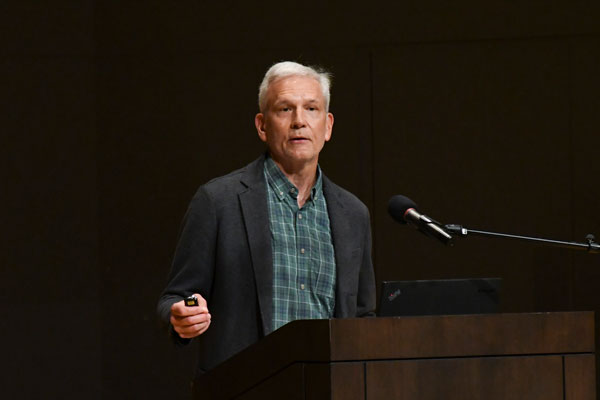
Ramseyer's grandmother Martha Graber maintained that she was willing to give her life for the country as a nurse but could not agree to kill on its behalf.
Ramseyer shares grandmother’s fight for citizenship during Bluffton Constitution Day Forum
A question posed nearly a century ago to Bluffton University alumni Rick Ramseyer’s grandmother continues to raise important questions about citizenship, conscience and what it means to serve one’s country.
Ramseyer ’83, a journalist and author, shared the story of his maternal grandmother, Martha Graber, a Mennonite registered nurse and conscientious objector who was twice denied U.S. citizenship after refusing to say she would take up arms to defend the United States.
Graber instead maintained that she was willing to give her life for the country as a nurse but could not agree to kill on its behalf.
Her decision launched a 19-month struggle that included initial citizenship denials, a contentious congressional hearing, involvement from religious and peace organizations and widespread newspaper coverage. Her case was also connected to a controversial U.S. Supreme Court decision concerning conscientious objection and citizenship.
Ramseyer’s presentation, “Steadfast Faith: Martha Graber’s Landmark Fight for U.S. Citizenship,” drew on the research behind his recently published book, "Girl Without a Country: The Untold Story of a Landmark Fight for U.S. Citizenship," published in August by Purdue University Press.
The story began for Ramseyer decades ago when, as a middle school student, he discovered a box of his grandmother’s papers and newspaper clippings. Years later, those materials became the foundation for a decade of research into Graber’s citizenship fight.
Graber came to the United States from Alsace-Lorraine in 1910 with her widowed mother and six siblings. She later became a registered nurse and moved to Bluffton in 1925 to attend classes at Bluffton’s affiliated theological seminary and serve as nursing superintendent at Bluffton Hospital. During her time in Bluffton, she met Carl Landes, who would become her husband and an advocate during her citizenship case.
Ramseyer described Graber’s first citizenship hearing in 1929, when she was asked whether she would be willing to take up arms and defend the nation. Her answer: that she would serve as a nurse and even give her life for the country but would not take a life. This led to her first denial of citizenship.
Her second hearing proved equally contentious. Ramseyer shared portions of the courtroom exchange in which a judge repeatedly questioned Graber about why she would not agree to bear arms. Graber invoked her religious convictions and questioned whether the government should determine the boundaries of her conscience.
The case attracted national attention. Newspaper coverage described Graber as a “girl without a country,” while religious organizations, attorneys, peace advocates and others became involved in her fight. Her story ultimately became part of a broader history of conscientious objection and the evolving relationship between religious conviction and citizenship.
Ramseyer connected his grandmother’s story to Bluffton’s own history of wrestling with questions of war, peace, service and conscience. He highlighted several individuals connected to Bluffton and the Mennonite community whose lives reflected different responses to military service and conscientious objection.
“Many of us, especially those who were born in the United States, may take citizenship for granted,” Ramseyer said. “For others, including those whose religious beliefs may conflict with governmental expectations, citizenship is far from a certainty.”
He noted that U.S. citizenship law has since changed. Today, individuals with sincerely held religious, moral, or ethical beliefs may seek modifications to portions of the oath of allegiance concerning bearing arms or performing noncombatant military service.
Ramseyer encouraged the audience to consider Graber’s story not simply as a historical account, but as an opportunity to reflect on civic responsibility.
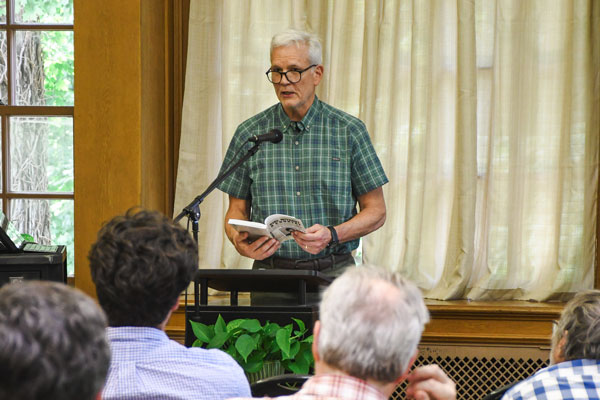
Ramseyer’s visit continued at 4 p.m. with a book celebration in the Musselman Library Reading Room. He shared additional sections of his story, answered questions from attendees and made copies of "Girl Without a Country" available for purchase.
The Constitution Day Forum and book celebration were free and open to the public and
served as Bluffton’s Constitution Day annual educational event.
All educational institutions which receive federal funds are required to offer an instructional program each year on or near Sept. 17, the day the U.S. Constitution was signed in 1787.By offering this annual event, Bluffton University continues to engage students and the broader community in conversations about democracy, civic responsibility and the values that shape society.