Importance of Integrity
08/20/2026
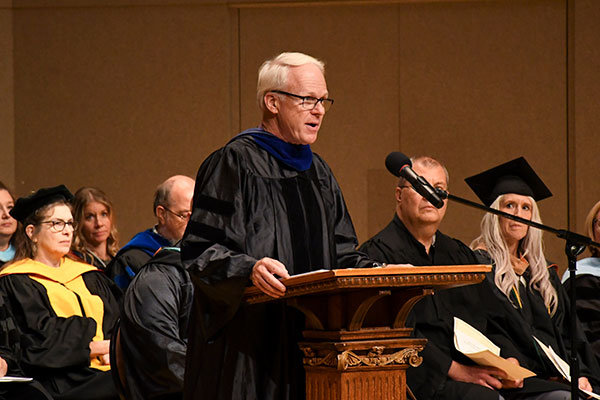
Bourassa connected the conversation about AI to the broader importance of integrity, describing it as a value that builds trust and strengthens communities.
Opening Convocation Addresses First-Year Students
Bluffton University officially welcomed its 127th class during Opening Convocation Tuesday, Aug. 18. First-year and transfer students were formally welcomed to the university as Vice President and Dean of Academic Affairs Dr. Mary Robinson read their names.
Dean of Students Dr. Mark Bourassa delivered the Convocation address, introducing the 2026 Civic Engagement theme, “Truth and Integrity in an Age of AI.” The theme will guide conversations, learning and reflection across the university throughout the academic year, culminating in Civic Engagement Day next April.
Bourassa began by asking students to consider why they chose college and, more specifically, why they chose Bluffton.
“A lot of you may think that this is a path to a job or career, preparation for meaningful work,” he said. “And that definitely will be an outcome for the Bluffton experience.”
But a Bluffton education, he explained, is about more than career preparation. Students will also develop critical thinking, problem-solving, creativity, relationship-building and perseverance, along with values such as integrity, responsibility, trustworthiness, respect, kindness and compassion.
“These are things that are not going to be all encapsulated in a single course,” Bourassa said. “You can expect experience developing these skills, both in and out of the classroom, during your entire Bluffton experience.”
Each year, Bluffton selects a Civic Engagement theme to encourage shared study and conversation across disciplines and areas of campus. This year’s theme focuses on the opportunities and challenges created by artificial intelligence, particularly its relationship to truth, integrity and academic life.
“As we live through the early stages of an artificial intelligence revolution, we are faced with new versions of questions that humans have to wrestle with throughout our existence,” Bourassa said.
Among those questions are what it means to live authentically when AI can replicate things once considered uniquely human, how to maximize AI’s benefits while guarding against harmful applications, and how students can use AI while remaining true to Bluffton’s Honor Code and academic integrity.
Bourassa connected the conversation about AI to the broader importance of integrity, describing it as a value that builds trust and strengthens communities. “We also talk about integrity as a way that one should live,” he said. “It's not only about how we live with ourselves, but it's also about how we live with others. Integrity is relational.”
Reflecting on his more than 35 years at Bluffton, Bourassa recalled being struck by the university’s culture of trust and respect when he first joined the community.
“A culture and market center where students left their belongings unattended in the hallways with the full expectation that those things would be there when they returned,” he said. “And then there was this honor system, a value-based code where the assumption of behavior in the classroom was not that it was full of cheaters, but just the opposite, that students were trusted, assumed to be people of integrity, and treated highly.”
Through his work studying Bluffton’s Honor Code and talking with alumni about their experiences, Bourassa identified five values that repeatedly emerged: honesty, trust, fairness, respect and responsibility.
“These words should not be surprising to us,” he said. “The challenge we have is if we believe that integrity is an important virtue for us as a society, then we should be asking what behaviors create, support, and nurture such a place.”
As the university explores the Civic Engagement theme throughout the year, Bourassa challenged students, faculty and staff to engage in conversations about the ethical use of AI and the values that should guide the Bluffton community. He also encouraged students to think critically about the information AI provides and their responsibility to determine what is true.
“We should ask ourselves, how do we know what is true? What sources do we trust? How can I verify this fact? Where can I find another perspective? And what responsibility do we have to verify it before sharing it?” Bourassa said.
Ultimately, he encouraged the Bluffton community to allow the values of honesty, respect, responsibility, fairness and trustworthiness to guide the year ahead.
“As we take this year to reflect on truth, integrity and the age of AI, I invite all of us to consider these questions and the context and surroundings,” Bourassa said. “Let those values inform behaviors that support a kind of community where we can live and learn together.”
The 2026 Civic Engagement theme will continue to be explored through classroom discussions, chapel programs, student organizations and other campus activities throughout the academic year.