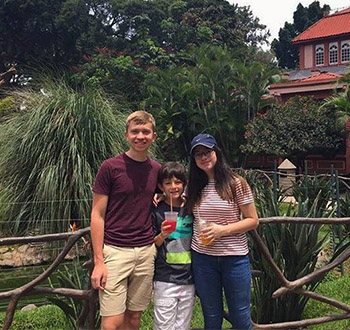
“From watching the sunrise at the top of a mountain or climbing an active volcano
to kayaking on a gorgeous lake and swimming under a remote waterfall, endless opportunities
for adventure are waiting for you in Guatemala. While your peers are studying for
finals in the cold winter, you could be relaxing on a black sand beach by the ocean!”
-Jacob Regier '20
Guatemala
Spend a semester experiencing the colorful culture and beautiful landscape of Guatemala!
You will spend time in the capital city and in rural areas; experience bustling markets, visit cooperatives and learn how crafts are made, visit Ancient Mayan ruins, eat local foods, and practice your Spanish language.
Bluffton students will live with Guatemalan families in Guatemala City and take Spanish classes at CASAS (Central American Study and Service). In addition, you will have classes about Guatemalan history and culture and about making peace. A volunteer field experience will give you the experience of a second Guatemalan community and an organization working to better the lives of the people in the community.
WHY GUATEMALA?
You live with Guatemalan families
Five-week volunteer field experience following class weeks
Week of FREE travel during semester
Safety
The CASAS staff has 20 years of experience teaching international students how to be safe in Guatemala City. Additionally, your host family is a great resource in helping you participate in daily life in an unfamiliar culture.
ACADEMICS
Dates
Fall semester (end of August to mid-December)
Classes
Bluffton University students will take classes together as a group.
Spanish (8-9 hours)
An introduction to Mayan Culture. The course utilizes various anthropological perspectives and practices to understand history and Mayan culture and its role in the current Guatemalan society.
The course offers the opportunity to participate in the development of contextual social and communitarian projects. It includes a minimum of 100 hours of volunteer work, a daily work journal and a final essay in which the student analyses and reflects on the experience and the implications for life and vocation.
The course introduces students to a variety of tools to help identify and analyze the roots and causes of violence in Central America. The situation of peace and justice in Central America, especially in Guatemala, will be analyzed along with the contributions an Anabaptist perspective makes to Christian faith.
The CASAS website can be accessed directly at: https://semillagt.org/casas_programs/
LIVING ARRANGEMENTS
In addition to being academic, the Guatemala semester is experiential. During the first 8-9 weeks, students will live with host families in Guatemala City. Following these weeks of classes, students will participate in a volunteer field experience for 4-5 weeks. This volunteer placement will likely be in a rural area of Guatemala, so students will have an opportunity to experience a different side of Guatemala. Students will be living with new host families during this time.
COST AND APPLICATION
Application and selection process for a semester in Guatemala
- Applications are available in the Cross-cultural Programs office (College Hall, second floor).
- Applications for the fall are due by the end of the following spring semester (submitted with a $200 deposit).
- Shortly after the application deadline, a committee will select the students who will be accepted.
Eligibility
- Undergraduate students in good standing with the university may apply.
- Majors from all disciplines are welcome.
- GPA requirement: 2.5 or above
Cost
- Bluffton University tuition, room and board (20 meal plan)
- $2,000 program fee (includes round-trip airline ticket, books, week of travel during semester)
- Passport (valid for six months after the end of the program)
- Possibly some immunizations
Grants & Financial Aid
- $600 grants are available for the Guatemala semester. Applications are available in the Cross-cultural Program Office in College Hall.
- Students will continue to receive eligible financial aid just as you would if you were taking classes on Bluffton's campus, including federal, state and institutional-based aid.
- Students will not be charged for books or the technology fee during the semester in Guatemala.
If you have questions regarding financial aid, you may contact our financial aid office
at finaid@bluffton.edu.
Contact
Noah Heiing, Cross-cultural coordinator
heiingn@bluffton.edu
Academic Information
Dates
Fall semester (end of August to mid-December)
Classes
Bluffton University students will take classes together as a group.
- Spanish (8-9 hours)
- CHS 133 Introduction to Central America (3 hours)
This is a panoramic introduction to primary themes of history, culture and current events of Central American society. This course facilitates a cultural adaption to and entrance into the Central American realities and context. - CHS 233 Religious Studies: The church in Guatemala and Central America (3 hours)
This covers the principal religious expressions found in Central America. The course focuses on the various relevant religious movements including liberation theology, the Pentecostal and Neo-Pentecostal phenomenon and the theology of “a third way” that Anabaptism offers. Mayan spirituality will also be considered. - CHS 234 Anthropological Perspectives in a Guatemalan Context (2-3 hours)
An introduction to Mayan Culture. The course utilizes various anthropological perspectives and practices to understand history and Mayan culture and its role in the current Guatemalan society. - CHS235 The Practice of Communitarian Learning (3 hours)
The course offers the opportunity to participate in the development of contextual social and communitarian projects. It includes a minimum of 100 hours of volunteer work, a daily work journal and a final essay in which the student analyses and reflects on the experience and the implications for life and vocation. - CHS 333 Violence, Justice and Peace in Central America (Peace Studies) (3 hours)
The course seeks to introduce the student to a variety of tools to help identify and analyze the roots and causes of violence in Central America. The situation of peace and justice in Central America, especially in Guatemala, will be analyzed along with the contributions an Anabaptist perspective makes to Christian faith.
The CASAS website can be accessed directly at: https://semillagt.org/casas_programs/
“From watching the sunrise at the top of a mountain or climbing an active volcano
to kayaking on a gorgeous lake and swimming under a remote waterfall, endless opportunities
for adventure are waiting for you in Guatemala. While your peers are studying for
finals in the cold winter, you could be relaxing on a black sand beach by the ocean!”
-Jacob Regier '20