Spiritual Life Week Forum Recap
03/26/2026
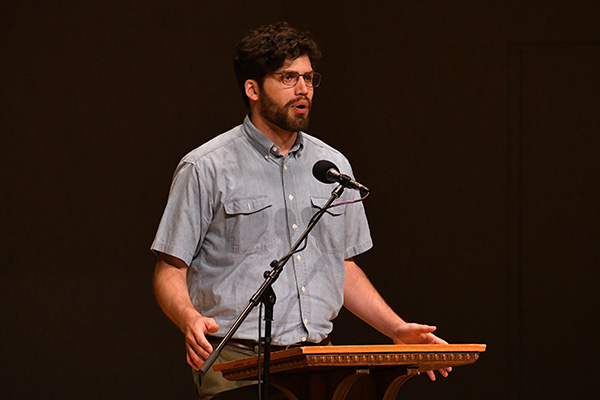
Throughout the presentation, Yoder highlighted the inherent tension between inclusion and exclusion, reminding the audience that “where there is belonging, there are also those who don’t belong.
Spiritual Life Week Forum Addresses Our Duty to Embrace Neighbors
Rev. Phil Yoder challenged Bluffton University students, faculty and staff to reconsider the role of belonging in their lives during the Spiritual Life Week Forum. Yoder reflected that while belonging is deeply desired and ingrained in us, it can come at a cost to others.
Opening with a familiar campus experience, the Yoder invited listeners to recall moments of uncertainty and isolation: “Have you ever walked into the dining hall, looked around, had no idea where to sit?” He suggested that beneath that experience lies a deeper question: “Do I belong here?”
The speaker defined this feeling as alienation, explaining, “Alienation is the feeling that you have when you scan the cafeteria, panicking, looking for a place to sit.” While belonging is often seen as the solution to this discomfort, he encouraged the audience to examine it more critically.
“Belonging is super important,” he acknowledged, noting that it can “reduce anxiety, provide emotional safety, and it creates friendships that can support one another.” However, he emphasized that belonging is not without consequences. “Yes, we need belonging, but… the quest to belong can harm others.”
Throughout the presentation, Yoder highlighted the inherent tension between inclusion and exclusion, reminding the audience that “where there is belonging, there are also those who don’t belong.” He added, “Every time there’s an inside, there’s an outside,” underscoring how communities, even unintentionally, can push others to the margins.
He suggested that this dynamic is often driven not by malice, but by fear. “People are usually not awful to others because they’re simply awful people, but because they are anxious about not belonging,” he said.
Using cultural examples, including the film “Mean Girls,” he illustrated how the desire to belong can shape behavior and identity. Even when individuals achieve belonging, he noted, it does not resolve deeper feelings of isolation.
Drawing from the Bible, Yoder offered an alternative framework centered not on belonging, but on presence. He described how Jesus consistently aligned himself with those on the margins, choosing connection over social acceptance.
This distinction led to one of the central ideas of the Forum: “This is the difference between belonging and presence: Belonging says, ‘be like me’. Presence says, ‘I’ll stay with you, even when we are different.’”
Rather than seeking to eliminate alienation through belonging, the speaker encouraged the Bluffton community to become more aware of who may be excluded in the process. He posed a simple but challenging question: “Who are we leaving out? Who’s not invited?”
Concluding the presentation, Yoder emphasized that belonging alone cannot fulfill the human need for connection. “Belonging never satisfies, but presence stays,” he said, inviting listeners to consider how they might show up for others—especially those on the fringes—with intentional presence and care.