Keeney Peace Lecture Recap
02/04/2026
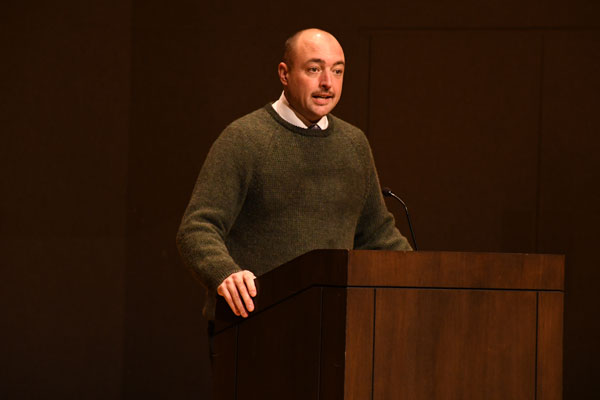
Throughout the lecture, Moyer challenged listeners to examine the moral frameworks that guide decision-making, contrasting outcome-based reasoning with duty-based ethics rooted in faith.
Bluffton University hosts Dr. Jonathan Moyer for 48th annual Keeney Peace Lecture
Bluffton University welcomed alumni Dr. Jonathan Moyer ’02 back to campus as the featured speaker for the university’s 48th annual Keeney Peace Lecture, an event that invites the campus community to reflect on faith, justice and peacemaking in today’s world.
Bluffton’s Keeney Peace Lectureship was established in 1978 by the family of William Sr. and Kathryn Keeney to express appreciation for Bluffton’s influence and to strengthen the continuing peace witness among the community. Over the decades, the series has brought noted scholars, activists and faith leaders to campus to explore issues of service, reconciliation and peace.
Moyer, now an associate professor at the University of Denver and director of the Frederick S. Pardee Institute for International Futures, studies how global systems, including population, governance, education, and the environment, shape long-term stability and conflict. His research has informed work with partners such as USAID, the United Nations and other governmental and nongovernmental agencies.
Returning to Bluffton, Moyer reflected on both his professional work and his Mennonite faith tradition. “I am humbled to be invited back to my alma mater to give a Keeney lecture,” said Moyer. “This is a place that holds history for my family.”
Framing his talk around Anabaptist theology and international relations, Moyer explored what he called the tension between Christian pacifism and the modern nation-state.
“I want to take you on a journey that will focus on Anabaptist pacifism and the problem of sovereignty,” he said. “Put more simply, what is a Mennonite foreign policy?”
Drawing from his academic expertise and faith convictions, Moyer argued that the structure of the state relies on violence in ways that conflict with Mennonite commitments to nonviolence and service.
Throughout the lecture, Moyer challenged listeners to examine the moral frameworks that guide decision-making, contrasting outcome-based reasoning with duty-based ethics rooted in faith. “The world and the state operate on consequentialist ethics,” he explained. “The kingdom, however, lives for the truth irrespective of the outcomes.”
He emphasized that for pacifists, faithfulness requires action even when it carries personal risk. Reflecting on the distinctives of the Anabaptist tradition, he reminded students that Bluffton’s heritage welcomes people from many backgrounds while continuing its historic peace witness.
“Do not be afraid, for all are welcome here,” he said.
The Keeney Peace Lecture remains a signature event at Bluffton, encouraging thoughtful dialogue about how faith shapes responses to conflict and injustice. By bringing alumni and leaders like Moyer back to campus, the series continues to connect Bluffton’s academic mission with its longstanding commitment to peace, service and community engagement.