Why College Panel Recap
01/21/2026
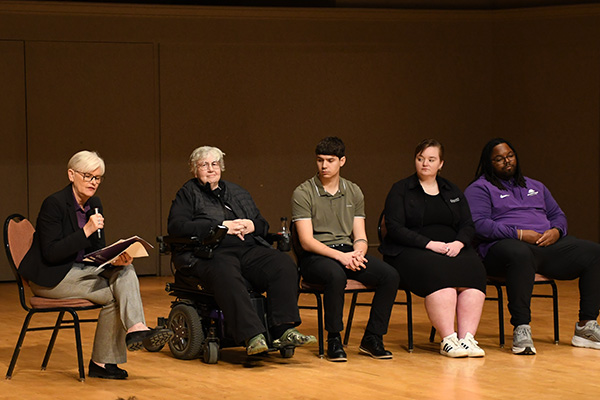
Panelists representing academic, administrative and athletic roles at the university spoke openly about their own paths through college.
First-generation college students share the motivations behind their college journey
Bluffton University hosted a “Why College?” forum featuring reflections from a panel of first-generation college graduates who shared candid insights about the challenges, growth and long-term value of earning a bachelor’s degree.
Dr. Gayle Trollinger, interim vice president and dean of academic affairs, framed the conversation around the purpose of higher education, emphasizing that a liberal arts degree prepares students not only for careers, but for life. “At its very best, a liberal arts bachelor’s degree helps people develop not just professional skills but deeper ways of thinking,” she said. “Students learn how to evaluate information carefully, communicate clearly and work with others, and adapt when things change.”
She noted that these skills extend far beyond a first job. “These abilities serve people well in every single vocation and in every single season of life.”
From a faith perspective, Trollinger described education as stewardship. “Education can be seen as a way of being a steward of the gifts that God has given us. Learning is not only about achievement, but about belonging to people who can serve others with wisdom and integrity.”
The forum centered on the experiences of first-generation college students, acknowledging both opportunity and pressure. Trollinger reminded students that perfection is not the goal. “Learning involves trial, reflection, and progress, not always perfection,” she said. “College is not about having everything figured out. It’s about showing up, doing the work, and continuing forward, even when things feel uncertain.”
Panelists representing academic, administrative and athletic roles at the university spoke openly about their own paths through college.
One panelist, Tami Forbes, associate professor of HFSS, shared how early work experiences shaped her decision to pursue higher education. “I worked in factories where everything was very repetitive,” she said. “One day, I drilled 957 holes, and I said, ‘This is stupid.’” This mundane repetition led her to get a bachelor’s degree that allowed her to pursue a passion for outdoor learning and teaching others.
Another panelist, Autumn Graves ‘21, Jenzabar administrator and data specialist, reflected on the freedom and responsibility of college life. “One thing that I found surprising about college was this idea of freedom,” she said. “The idea of freedom and structure is something that I was not expecting.”
Self-discovery emerged as a common theme. “I didn’t realize how much self-discovery I was going to experience in college,” said Darricle Jones, assistant football coach. “I found a lot more about myself, learned a lot about myself in college.”
Several panelists described navigating college systems without family experience to guide them. “It isn’t about intelligence, it’s about experience,” Trollinger said earlier in the forum. “And experience comes from practice, questions and sometimes a few missteps along the way.”
Students also discussed balancing academics with work, leadership roles and family responsibilities. Graves described working 25–30 hours a week while attending classes full time, noting that “a day off did not exist during college.”
When asked how being a first-generation student shaped their approach to challenges, one panelist, Carter Ritchey ‘25, admissions counselor, summarized the mindset that carried them forward: “I kind of adopted a mantra while I was here. ‘I’ll figure it out.’”
Trollinger closed by encouraging students to trust the long-term value of their education. “Your bachelor’s degree will represent more than academic achievement,” she said. “It will represent commitment, growth and the willingness to invest right now in a meaningful future.”